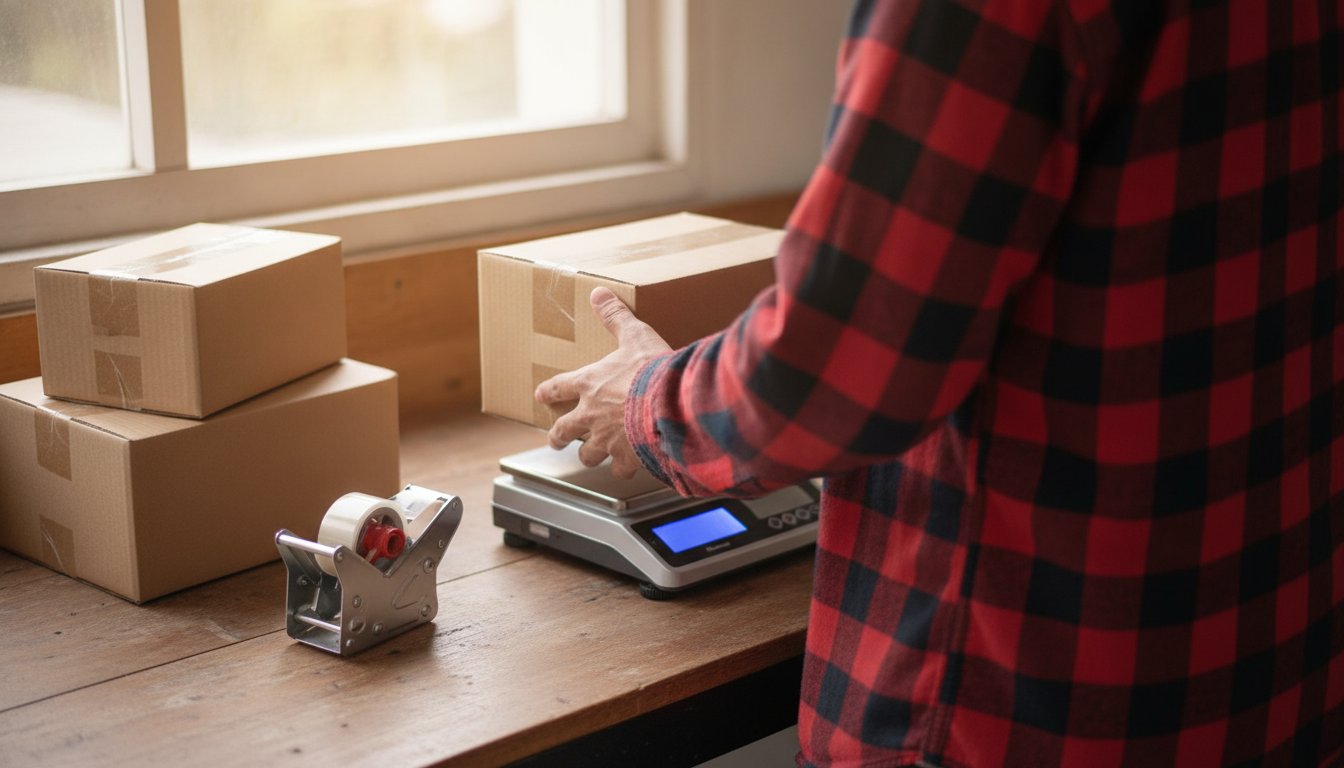
Here is how to calculate shipping costs for online store orders: weigh the packed box, take the greater of actual weight or dimensional weight, find the zone between your ZIP code and the buyer's, pull the carrier rate for that service, then add surcharges, packaging, and any marketplace fee on the shipping you charge.
We have packed and shipped online orders since 2005. This guide works one real box from the scale to the final number and builds on our guide to starting an online store.
What Determines How Much It Costs to Ship a Package?
What determines how much it costs to ship a package is a stack of six inputs, not a single number: billable weight, box dimensions, the distance the package travels, the service speed, carrier surcharges, and the packaging materials around the product. Carriers combine the first five into the label price. The sixth comes out of your pocket before the label is ever printed.
There is also a seventh input most guides skip. If you sell on a marketplace, the platform takes its commission on the shipping you charge the buyer, so part of every shipping dollar never reaches you. We cover that math in its own section below, because it is where most sellers quietly lose money.
How Do You Calculate Dimensional Weight?
You calculate dimensional weight by multiplying length by width by height in inches, dividing by the carrier's DIM divisor, and rounding up to the next whole pound. The carrier then bills whichever is greater: that dimensional weight or the actual weight on the scale. UPS publishes the formula and divisor values on its official support page.
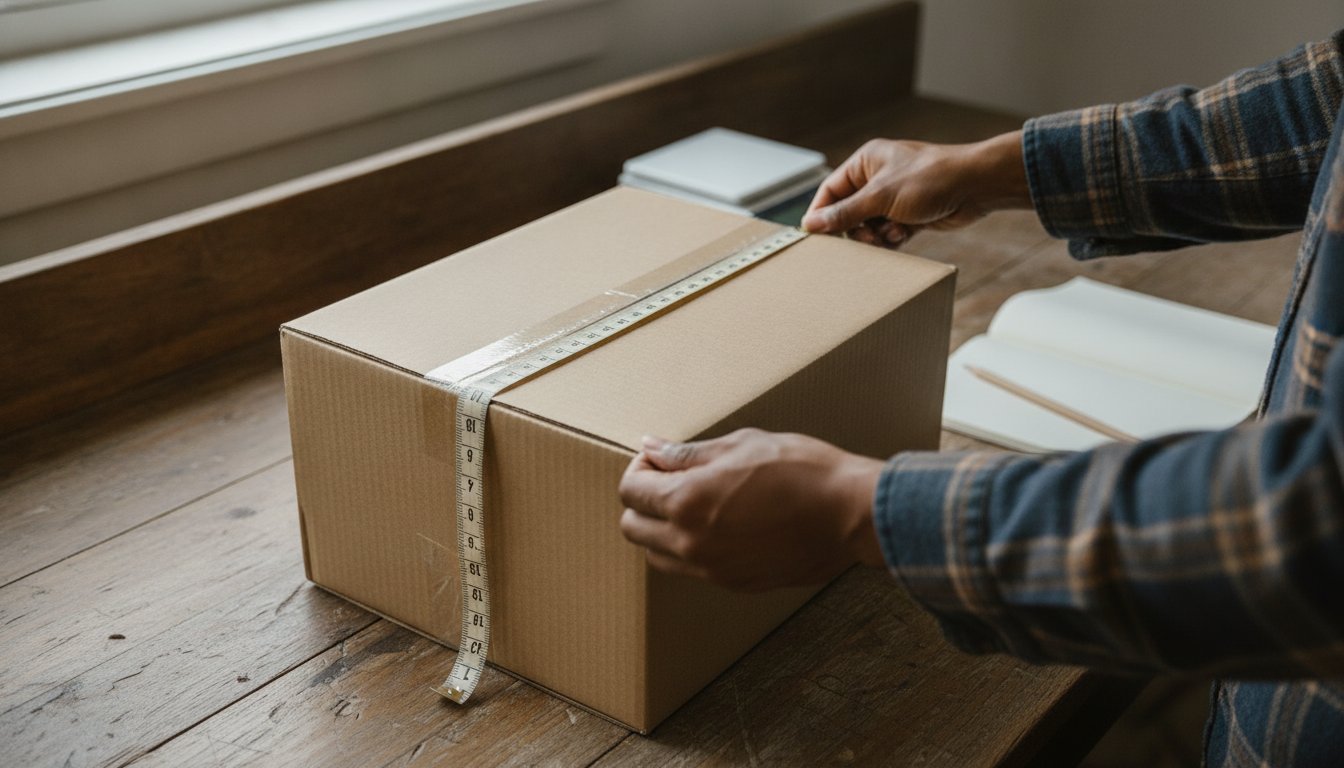
The divisors matter because a lower divisor produces a heavier billable weight. UPS and FedEx use 139 for daily and commercial rates, while UPS retail counter rates use 166. USPS historically used 166, then aligned to 139 effective July 12, 2026. Since August 18, 2025, UPS and FedEx also round every fractional inch up before running the formula, so an 11.1 inch side bills as 12 inches.
A quick worked run of the arithmetic: a 14 by 12 by 8 inch box is 1,344 cubic inches. Divide by 139 and you get 9.7, which rounds up to a 10 pound dimensional weight. If the packed box weighs 4 pounds on the scale, the carrier bills it as 10 pounds anyway.
| Rate type | DIM divisor | As of |
|---|---|---|
| UPS and FedEx daily or commercial rates | 139 | Current per UPS support page, retrieved late 2025 |
| UPS retail counter rates | 166 | Current per UPS support page, retrieved late 2025 |
| USPS Priority Mail and larger Ground Advantage | 139, was 166 | Aligned July 12, 2026 |
The price of a package is based only on how much it weighs.
Carriers bill the greater of actual weight or dimensional weight. A light but bulky box of lampshades can cost more to ship than a small dense box of hand tools.
How Do Shipping Zones Change the Price?
Shipping zones change the price by charging more at every weight tier as distance grows. USPS assigns each shipment a zone from 1 to 9 based on how far the destination ZIP code sits from the origin, and the same billable weight costs more in Zone 8 than in Zone 2. UPS and FedEx use their own distance bands that work the same way.
The second lever hiding inside the rate chart is retail versus commercial pricing. Retail Ground Advantage starts around $7.30 for a 4 ounce Zone 1 package under the January 2026 USPS price change filing. Commercial rates bought through label platforms run well below the counter price for the same package, with savings as high as 24 to 34 percent on light Zone 1 packages per Pitney Bowes' January 2026 rate guide.
Practical takeaway: never price your store off the counter rate. Buy labels through your platform's built-in tool or a free commercial-rate service, and quote from those numbers instead.
What Surcharges Get Added on Top of the Base Rate?
The surcharges added on top of the base rate include fuel surcharges, residential delivery fees, address corrections, and additional handling charges for large or awkward packages. None of them show up in a casual rate lookup, and together they are the gap between the price you expected and the invoice you got.
Size triggers are the ones that bite online sellers. FedEx applies its additional handling charge once a package passes 10,368 cubic inches starting January 12, 2026, and UPS applies its equivalent at the same threshold starting January 26, 2026. That is roughly a 22 by 22 by 22 inch box, common for lamps, framed art, and bulk orders.
How to Calculate Shipping Costs for Online Store Orders, Step by Step
This is how to calculate shipping costs for online store orders in six steps, worked on one example package: an 8 ounce handmade item packed in a 10 by 7 by 5 inch box, shipped coast to coast.
Now the full stack, in dollars. The box and padding figures are our stated example inputs; every rate and fee is a published number with its date. The math is plain arithmetic you can re-run yourself.
| Line | Amount | Where it comes from |
|---|---|---|
| Carrier label, 8 oz to Zone 8 | $6.24 | Commercial Ground Advantage rate, platform pull dated May 21, 2026 |
| Box and padding | $0.85 | Example inputs: a 60 cent box plus 25 cents of padding |
| Marketplace fee on the shipping charge | $0.59 | Etsy's 6.5 percent transaction plus 3 percent processing applied to a $6.24 shipping charge, per its 2026 fee schedule |
| True cost to ship | $7.68 | Sum of the three lines above |
| Shortfall if you charge the buyer $6.24 | $1.44 | $7.68 minus $6.24 |
That $1.44 is the profit leak. It looks small until you multiply it across a year of orders, and it exists because the label price is only part of the cost. Charging the raw carrier rate means every order ships at a loss you never see itemized.
The box you pick is a pricing decision, not a packing decision.
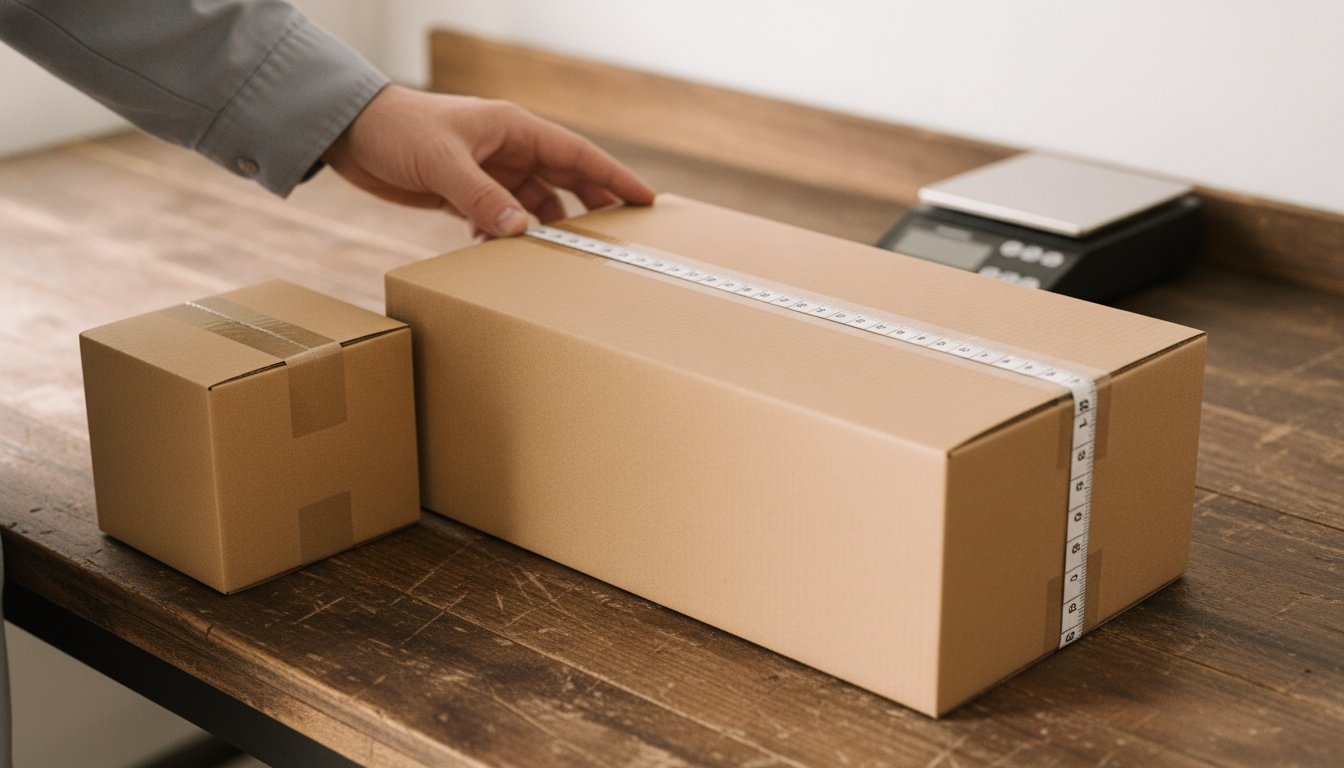
Here is the same rule from the other direction. Put that same 8 ounce item in a 16 by 14 by 12 inch box and you get 2,688 cubic inches, which is over one cubic foot, so dimensional weight applies. Divide 2,688 by 139 and you get 19.3, which rounds up to 20 pounds billable. Same product, same buyer, same zone, and the carrier now prices it as a 20 pound shipment.
| Box | Cubic inches | Billable weight |
|---|---|---|
| 10 x 7 x 5 inches | 350 | 0.5 lb (actual weight applies) |
| 16 x 14 x 12 inches | 2,688 | 20 lb (2,688 divided by 139, rounded up) |
Should You Charge Actual Cost, a Flat Rate, or Free Shipping?
Choosing between actual cost, a flat rate, and free shipping is a conversion decision as much as a math decision. Calculated shipping recovers your cost most accurately but shows the buyer a surprise number at checkout. A flat rate is predictable but overcharges some orders and undercharges others. Free shipping removes the objection entirely and moves the cost into your item price.
The checkout data is blunt about why this matters. Baymard Institute's running meta-analysis of roughly 50 studies puts average cart abandonment at just over 70 percent, and unexpected costs at checkout, led by shipping, are the top stated reason at roughly 48 percent of documented cases.
Our operating stance after twenty years of packing orders: small stores chase perfect per-cart calculated shipping and lose the war for the battle. If most of your orders fall in one or two weight bands, a flat or tiered rate built from your real average cost is honest, predictable, and takes five minutes to maintain. Save calculated shipping for catalogs where a mug and a mirror ship from the same store.
When does free shipping actually work?
Free shipping works when your average order value comfortably covers the built-in cost, or when a threshold such as free over a set amount nudges buyers to add one more item. It fails on low-priced heavy goods, where the buried cost eats the whole margin. Run the numbers on your own average order before copying what large retailers do.
How Do Marketplace Fees Change Your Real Shipping Cost?
Marketplace fees change your real shipping cost because most platforms take their commission on the total the buyer pays, including the shipping line. Charging $6.24 for shipping does not mean receiving $6.24. The worked table above already showed the Etsy version; the same rule applies nearly everywhere, and it also applies when shipping is free, because the commission then lands on the higher item price.
| Platform | Fee that touches shipping | As of |
|---|---|---|
| Etsy | 6.5% transaction plus about 3% and $0.25 processing, on item plus shipping | 2026 fee schedule; handling markups on calculated shipping ended March 2024 |
| eBay | About 13.6% final value fee for most categories on item, shipping, and tax, plus $0.30 to $0.40 per order | Current per eBay's fee page, 2026 |
| Amazon FBA | Fulfillment fee replaces your label: $3.06 to $3.70 small standard tier, plus a 3.5% fuel surcharge | Effective January 15 and April 17, 2026 |
| Walmart Marketplace | 8% to 20% referral fee; WFS fulfillment from $3.45 under 1 lb | Current per Walmart's published pricing, 2026 |
eBay's own fee page confirms its final value fee is charged on the total amount of the sale including shipping, and Walmart's published pricing lists its referral and fulfillment tiers. Amazon's figures come from its Seller Central fee change notices for 2026. Etsy also removed the option to add a handling markup on top of calculated shipping in March 2024, so Etsy sellers can only pass through the raw carrier rate there.
The practical rule: whatever you charge for shipping, multiply it by your platform's fee percentage and add that to your true cost. For the full fee stack beyond shipping, see our breakdown of what it costs to sell on Etsy.
Is Shipping Subject to Sales Tax?
Shipping is subject to sales tax in roughly half of the US states whenever the goods being shipped are taxable, including Texas, New York, Georgia, and Hawaii. Most of the remaining states exempt shipping when the charge is separately stated on the invoice, including California, Florida, Illinois, and Virginia, and five states have no state sales tax at all. TaxJar's state-by-state summary is a reasonable starting map.
We are a tech shop, not a tax office, and we do not give tax advice. The rules turn on your state, your buyer's state, and whether the item itself is taxable. Before you set your store's tax settings, put the question to an accountant or your state's department of revenue.
How Do You Find Your True Cost Per Order?
You find your true cost per order by adding up one full month of shipping spend and dividing it by the orders you shipped. Count label costs, boxes, mailers, tape, padding, label printer supplies, and the marketplace fees taken on shipping charges. The result is the number your flat rate or free-shipping price actually has to cover.
In the worked example above, the gap between the label price and the true cost was $1.44 per order before any labor. Your own gap is whatever the audit shows, and it is rarely zero. That gap is the reason a store can grow its order count all year and still watch margin shrink.

When is a spreadsheet all you need?
A spreadsheet is all you need when you ship a handful of orders a week in one or two box sizes. Weigh your three most common shipments, price them at commercial rates, set a flat rate near the average, and re-check quarterly. That is a solid system, and it costs nothing.
Stateline Tech provides ecommerce consulting for store owners who want the boxes, rates, and store shipping settings figured out once, correctly, with the fee math done on real numbers. Current rates are on our consulting pricing page. If your store runs without stock on hand, the same audit applies; see our guide to running a store without inventory.
Frequently Asked Questions About Shipping Costs
How much should you charge for shipping on an online store?
Charge your true average cost per order, not the raw label price. Add your typical commercial label rate, packaging materials, and the marketplace fee taken on the shipping charge, then set a flat rate near that total or build it into the item price. Re-check the average quarterly, because carrier rates changed multiple times in 2026 alone.
What is a shipping zone?
A shipping zone is a distance band carriers use to price a shipment. USPS assigns zones 1 through 9 based on how far the destination ZIP code is from the origin, and the same package costs more at every weight tier as the zone number rises. UPS and FedEx price with their own distance bands that work the same way.
Does Etsy charge fees on shipping?
Yes. Etsy applies its 6.5 percent transaction fee and its roughly 3 percent plus $0.25 payment processing fee to the full amount the buyer pays, including the shipping charge, per its 2026 fee schedule. Since March 2024 Etsy also blocks handling markups on calculated shipping, so the carrier rate passes through as-is while the fees still come out.
How do you get commercial shipping rates?
Buy labels through your selling platform's built-in label tool or a free commercial-rate label service instead of paying at the counter. Those channels sell the same USPS, UPS, and FedEx services at commercial pricing, which ran 24 to 34 percent below retail on light Zone 1 packages in Pitney Bowes' January 2026 rate guide. No minimum volume is required to start.
Is USPS or UPS cheaper for a small online store?
It depends on billable weight and zone, so compare both at commercial rates before choosing. USPS is usually strongest on small light packages, while UPS and FedEx compete on heavier boxes. Since USPS aligned its dimensional weight divisor to 139 in July 2026, all three carriers now price oversized boxes with the same formula, so the box size decision matters more than the carrier logo.
If you want your store's shipping priced so it stops leaking margin, our ecommerce consulting service will work the numbers with you: call (608) 214-5158.